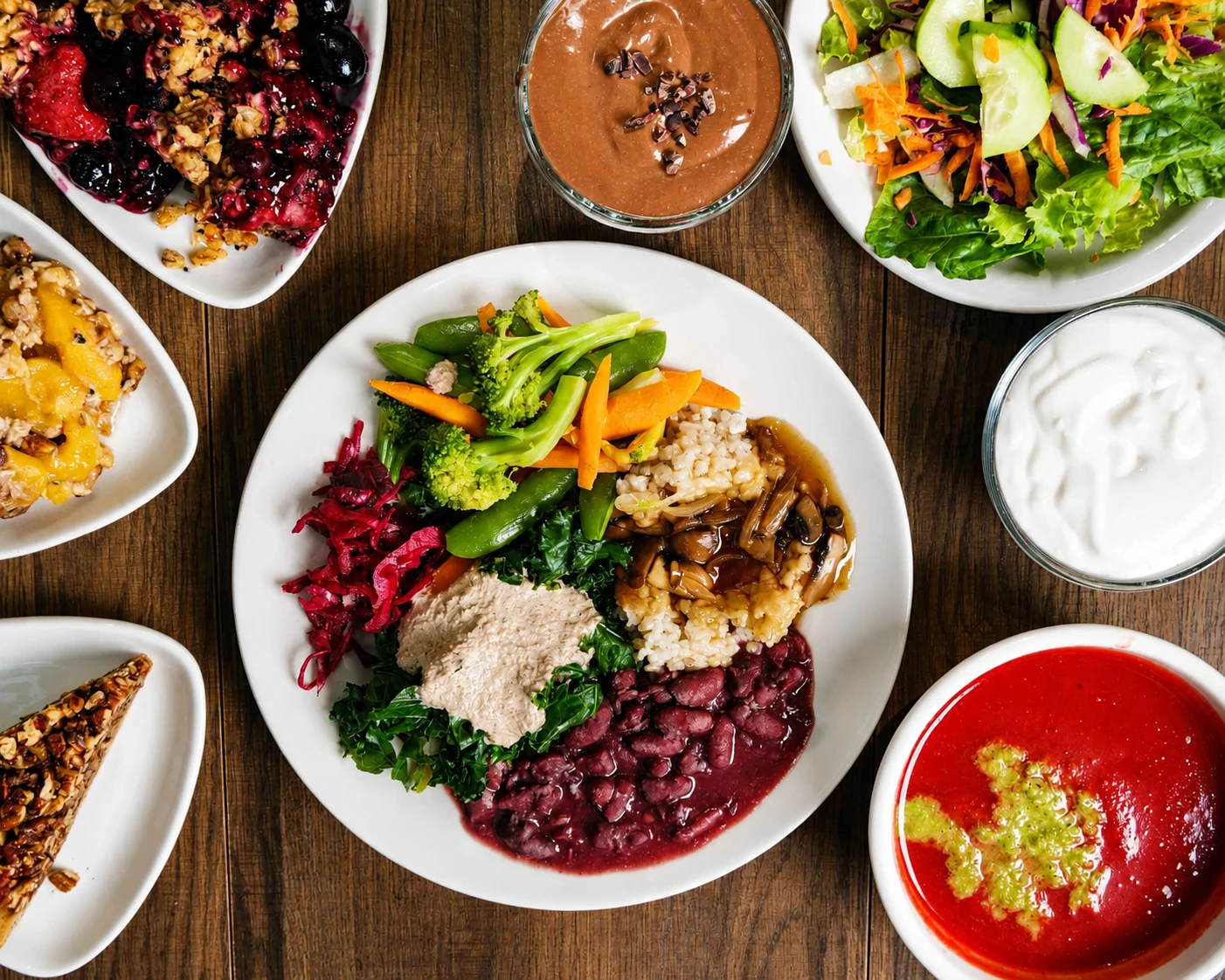
Neotraditional Food Systems

Change begins with
what we subsidize.

Neotraditional Food Systems (NFS) is my name for a food system in which whole-food, plant-based meals are the easiest and most ordinary way to eat, because public support stands behind them.

The problem is
the setup.

A food system is everything that gets food from production to the plate, and everything after: the waste, the effects on our health, and the costs someone eventually pays.

I’m not asking people to change, and I don’t expect them to. Most of us eat what is cheap, convenient, and normal. Many of our problems exist because the system that decides those three things is set up against our health and against the world we live in. That is the part we can change.

What counts as “the system”

Farms and supply chains, and also public budgets, school meals, stores, kitchens, and marketing. Together they decide which foods are cheap, convenient, and normal.

What the current system costs.

Five figures I keep coming back to. Each has its source beside it and its limits one click away.

Land

83%

83% of farmland18% of calories

of the world’s farmland is used for meat, dairy, eggs, and farmed fish, which supply 18% of the calories we eat.

Poore & Nemecek, Science, 2018 · Global

How to read this

A global estimate built from data on about 38,700 farms in 119 countries. “Farmland” here includes pasture and the cropland used to grow animal feed. It is a share of agricultural land, not of all land.

The same study found that even the lowest-impact animal products typically exceed the environmental impacts of plant substitutes.

Water

55%

of Colorado River water consumed

of all the water consumed in the Colorado River basin goes to irrigating crops grown to feed cattle.

Richter et al., Nature Sustainability, 2020 · Western United States

How to read this

A regional figure for one river basin. It counts water consumed: used up and not returned to the river. That is different from water withdrawn.

Worldwide, agriculture accounts for roughly 70% of freshwater withdrawals (FAO AQUASTAT).

Money

$470billion

87% of $540 billion in farm support

a year in government support to farmers worldwide either distorts prices or harms nature and health.

FAO, UNDP & UNEP, 2021 · Global

How to read this

This is the figure closest to my argument, because it describes public money that already exists. The report calls for repurposing that support, not eliminating it.

It is a global number, not a pool of money Austin can spend. The largest U.S. programs, including farm subsidies, are set federally.

Health

$604billion

$1.1 trillion spent on food$3.2 trillion true cost

a year in U.S. health care costs is attributable to diet-related disease, such as hypertension, cancer, and diabetes.

The Rockefeller Foundation, True Cost of Food, 2021 · United States, 2019 data

How to read this

An estimated cost, not a government budget line. The same report puts the “true cost” of U.S. food at $3.2 trillion or more a year, against the $1.1 trillion Americans spend on food.

A cost like this shows a burden a different system might reduce over time. It does not mean the money is available to redirect today, and it should not be added to the other figures here.

Globally, the 2025 EAT-Lancet Commission estimates that a shift to its planetary health diet could prevent up to about 15 million premature deaths a year.

Waste

30–40%

3 to 4 of every 10 pounds

of the U.S. food supply is never eaten, by the USDA’s own estimate.

U.S. Department of Agriculture · United States

How to read this

The estimate rests on 2010 data: 31% of the food available in stores and homes, about 133 billion pounds, went uneaten. It does not count losses on farms or between farm and store.

Worldwide, the UN estimates that 19% of the food available to consumers was wasted in 2022, most of it in households (UNEP Food Waste Index, 2024).

These numbers measure different things in different places. They can’t be added together, and none of them is an Austin number. Scaling figures like these to Travis County is the work of my thesis.

Three steps, in this order.

First

Restructure the incentives.

Public support makes some foods cheaper than others. NFS starts by tracing that money, the subsidies and institutional purchases behind what we eat now, and asking which of it could instead make whole-food meals affordable or free.

I mean money that already exists. Some of it is hard to trace and some can’t be changed locally, so finding what can move is part of the work. Whether it is enough is what the research has to show.

An example of what I mean

The Environmental Quality Incentives Program is a federal conservation program. From fiscal years 2019 through 2023, federal law required at least half of its payments to go to practices related to livestock production. Before 2019 the share was 60%.

Programs like this support animal agriculture under names that don’t sound animal-related. My thesis asks whether such funds could better serve their stated goals.
Then

Make good food truly accessible.

A grocery store nearby is not access. Access is a prepared meal that is affordable or free, close by, and good enough to choose again. A kitchen that cooks one meal in quantity for shared tables can offer that at low cost, with very little waste.

Belo Horizonte, Brazil, feeds more than 10,000 people a day this way. Its meals include meat: it is my example of access, not a vegan or whole-food, plant-based model.

How Belo Horizonte does it

The city runs public “popular restaurants” that serve lunch for under a dollar. By law, the price cannot exceed the cost of the meal. Its whole food-security program, restaurants included, costs less than 2% of the municipal budget, and it has run for more than thirty years (Rocha, 2019).

Ultimately

Incentivize only whole-food, plant-based food.

This is the most important step. In the end, I think public incentives should support whole-food, plant-based food and nothing else.

Choice and individuality are unalienable rights, and NFS bans nothing. But I believe it is wrong to subsidize animal products, which harm other living beings, our health, and the environment. What you eat is yours to decide. What we all pay to make cheap is a public decision.

What neo and traditional mean.

Neo

What is good about modernity

Nutrition science. Highly productive cultivation. Economies of scale. Nobody alive today should be without high-quality nutrition, and it is remarkable that so many people still are.

So NFS keeps modern tools: bulk purchasing, global supply chains, new technology. Nothing has to be local or old.

Traditional

What was good that we have lost

Communal dining. Food sovereignty. Real choice, which starts with being able to grow what you want for yourself. Better health, and more movement in an ordinary day.

Not everything about the past was better. These practices were, and we now have the means to offer them to everyone.

The name borrows from urban planning: New Urbanism was first known as neotraditional planning. I tell that story, along with the award that led to it, on the home page.

A framework
for change.
Room for choice.

I’m a lifelong vegan, and the welfare of animals matters to me. NFS carries that concern into a question about institutions.

Which meals should public systems make accessible, and what should they stop making artificially cheap? Answering that doesn’t require anyone to share my personal choices. It can begin with one kitchen, one school, or one group of people who want to take part.

How did we get to a place that harms us, and why do we keep going?

I don’t think the answer is bad individual choices. I see three things holding each other in place.

  1. Public support grew up around a few commodities.Farm support was built around storable crops such as corn, wheat, and soybeans, much of which becomes animal feed and processed ingredients. In U.S. policy, fruits, vegetables, and nuts are still officially “specialty crops.”
  2. The cheap, promoted option became the normal one.Ultra-processed foods now supply 55% of the calories Americans eat (CDC, 2021–2023). In my own research near two Austin high schools, promotions for processed food were far more common in the stores near the lower-income school.
  3. The fixes are aimed at individuals.Advice, labels, and “food desert” maps ask people to choose better inside the same environment. One national study found that giving low-income households the same stores and prices as high-income households would close only about a tenth of the gap in healthy grocery purchases (Allcott et al., 2019).
Why I think this can change

Taste and habit are not fixed. In one classic study, people who cut back on salt for a few months came to prefer less of it (Bertino et al., 1982). At Casa de Luz I have watched the same thing happen with whole foods, in a room full of people eating the same meal.

The policies are not fixed either. Subsidies, purchasing rules, and program budgets are set by people and can be reset by them.

How NFS relates to
diets you already know.

IdeaWhat it describesThe question it raises for NFS
Standard American Diet (SAD)Not a prescribed diet. A shorthand for how Americans eat on average: more than half of calories from ultra-processed foods (CDC), and less produce than federal guidelines recommend.This is the diet our current incentives produce. Which of those incentives can be changed?
VeganismAn ethical commitment to avoid the use of animals.How can public systems support whole-food, plant-based eating and reduce harm to all living beings, without it feeling like dogma?
Whole-food, plant-based (WFPB)What is on the plate: whole grains, legumes, vegetables, fruits, nuts, and seeds. Some definitions allow a little animal food. I use it to mean none.Why aren’t these simple foods the most affordable and convenient ones?
Planetary health dietA scientific reference diet for human and planetary health from the EAT-Lancet Commission. Mostly plants, with limited animal foods allowed.We know what is good for us. How do we change the structures and begin putting these practices in place?
Neotraditional Food SystemsThe food, the shared setting, and the public support behind both.Can restructuring what already exists, without new money, be the implementation that actually works?
Read a fuller comparison.
How Neotraditional Food Systems compares with related diets and movements
ComparisonStandard American Diet (SAD)VeganismWhole-food, plant-based (WFPB) dietPlanetary health diet (EAT-Lancet)Neo-traditional dietary pattern (recent literature)Neotraditional Food Systems
Defined byHow Americans eat on average; not a prescribed dietAn ethical commitment to avoid animal productsWhat is eatenA scientific reference diet for human and planetary healthAn observed local eating patternHow a food system makes healthy eating the easy default
Animal productsEaten without a set limitNoneNone, as I use the term. Some definitions allow small amountsUp to about two servings a day, about one serving of red meat a week, no minimumIncludes seafoodNot publicly supported. What individuals eat is their own decision
Processed foodsMore than half of calories come from ultra-processed foodsAllowedAvoidedLimited; whole and minimally processed plant foods preferredExplores dual consumption of industrialized foods and WFPBWhole foods by default; nothing is banned
How food reaches peopleMostly retail and restaurants, one purchase at a timeNot addressedNot addressedPolicy shifts at the global scaleLocally produced foodMeals cooked in quantity, served communally, affordable or free
Locality and traditionNot addressedNot addressedNot addressedAdvocates for both locality and traditionTied to local and traditional foodsRecovers communal dining and food sovereignty; accepts global supply chains, non-native crops, and new technology
Role of public supportShaped by existing subsidies and food assistanceNoneNoneRecommends shifting subsidies and policyNoneCentral: restructure existing incentives first, then funding, purchasing, and logistics

Planetary health diet limits are from the 2025 EAT-Lancet Commission. The neo-traditional dietary pattern is described by DiBello et al. (2009) and Marrero et al. (2023); it is a separate use of a similar term. On cost: a 2021 modelling study estimated that in high-income countries, vegan diets built from whole foods cost up to a third less than current diets (Springmann et al.).

“When diet is wrong, medicine is of no use.
When diet is correct, medicine is of no need.”Ayurvedic proverb, lettered above the door at Casa de Luz
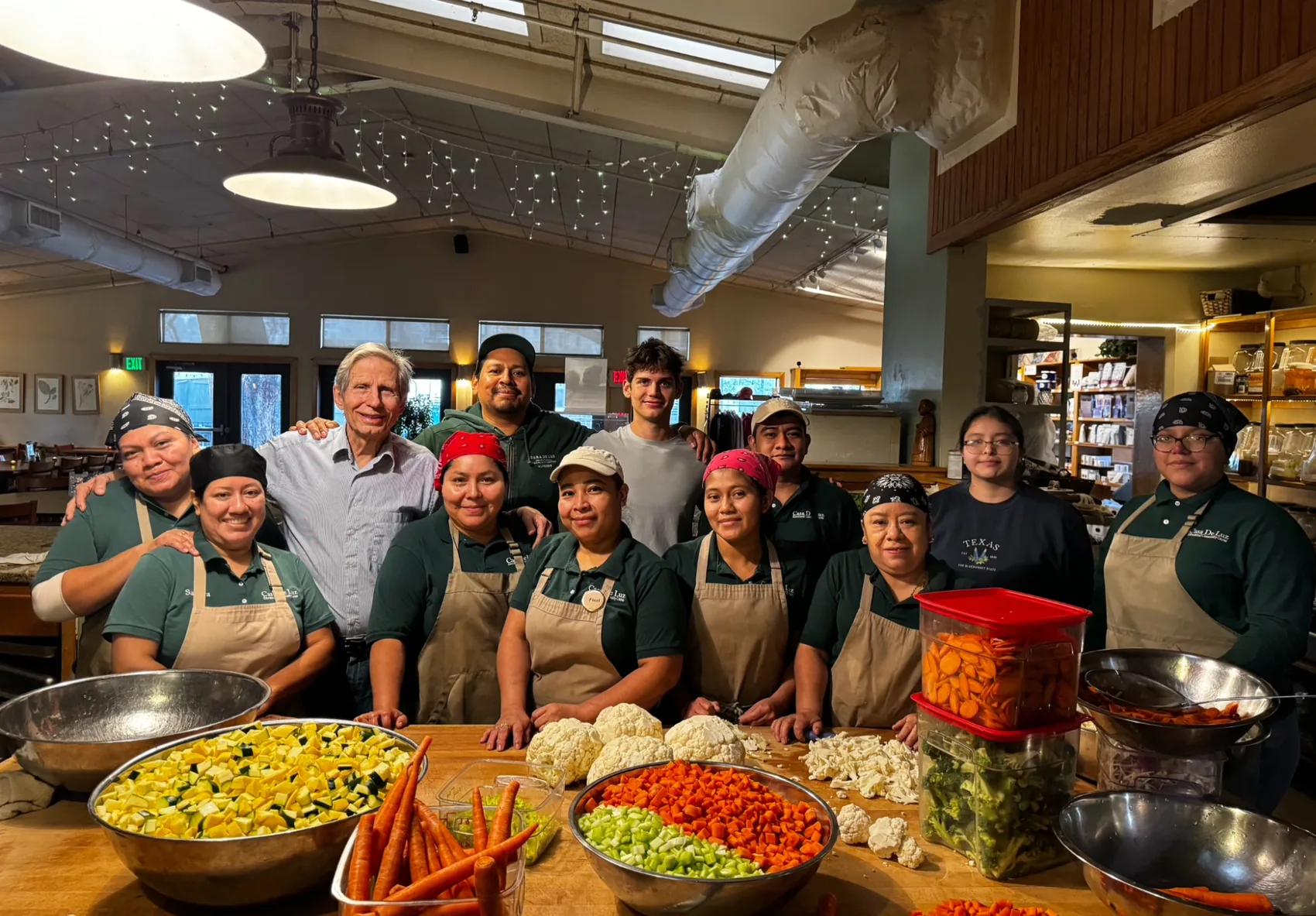
The Casa de Luz kitchen team standing behind large bowls of vegetables and grains
The kitchen at Casa de Luz, open every day of the year.

Casa de Luz
is a starting point.

Casa has served whole-food, plant-based meals in Austin since 1989. When everyone at every table eats the same simple meal, a healthy meal stops being a statement. It’s just lunch.

My family founded Casa and I have worked there. I say so wherever I use it as evidence. One dining room can’t answer for a city, so my thesis asks what its records can show and what still needs testing.

How the dining room works

Everyone eats the same meal and pays the same price. There are no waiters, and guests bus their own tables. Because the kitchen cooks one meal in quantity, roughly the same small team is needed whether the room is quiet or full.

By my own observation, the scraps and plate waste for the whole operation usually fit in a single 25-gallon compost bucket.

What it can’t do yet

The price has to cover rent, taxes, and wages along with the food. Today there is no way to charge less to the people who need it most without charging everyone else more. That is the kind of gap public support could close.

“I arrived at the Casa de Luz Village for the food, but I stayed for the community.”Nicholas Wagner, community member, in CNU’s feature

I hear the reverse just as often: people who came for the community, didn’t enjoy the food at first, and now crave it.

The research behind the idea